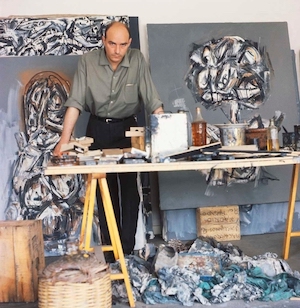
Antonio Saura
Antonio Saura was born on September 22, 1930, in Huesca, Spain. He grew up in a family with a strong artistic inclination, which significantly influenced his early interest in art. Saura's father, Antonio Saura Atarés, was a prominent lawyer and writer, while his mother, María de los Dolores Atarés, was a painter. This artistic environment nurtured Saura's talents from a young age. He began his formal art education at the School of Fine Arts in Madrid, where he studied under the guidance of renowned artists such as Daniel Vázquez Díaz and José Caballero.
Saura's artistic career spanned over five decades, during which he explored various styles and mediums. He is particularly known for his abstract and figurative paintings, which often delve into themes of existentialism, human suffering, and the complexities of the human condition. His work is characterized by bold, expressive brushstrokes and a rich use of color, which convey a deep emotional intensity. Saura's contributions to the art world earned him numerous accolades, including the National Prize for Plastic Arts in 1982 and the Velázquez Prize for the Arts in 1992.
Throughout his life, Saura was also deeply involved in social and political issues. He was an active participant in the Spanish resistance against Franco's dictatorship and used his art as a means of protest and expression. His commitment to social justice and human rights is evident in many of his works, which often address themes of oppression, freedom, and the struggle for dignity. Saura's legacy continues to inspire artists and art enthusiasts around the world, and his contributions to Spanish and international art are celebrated for their depth and innovation.
Photo: Madrid 1962 © Chiara Samugheo